Why use oxygen absorbers: what they add to a package, when they pay off and where their limits are
Short answer
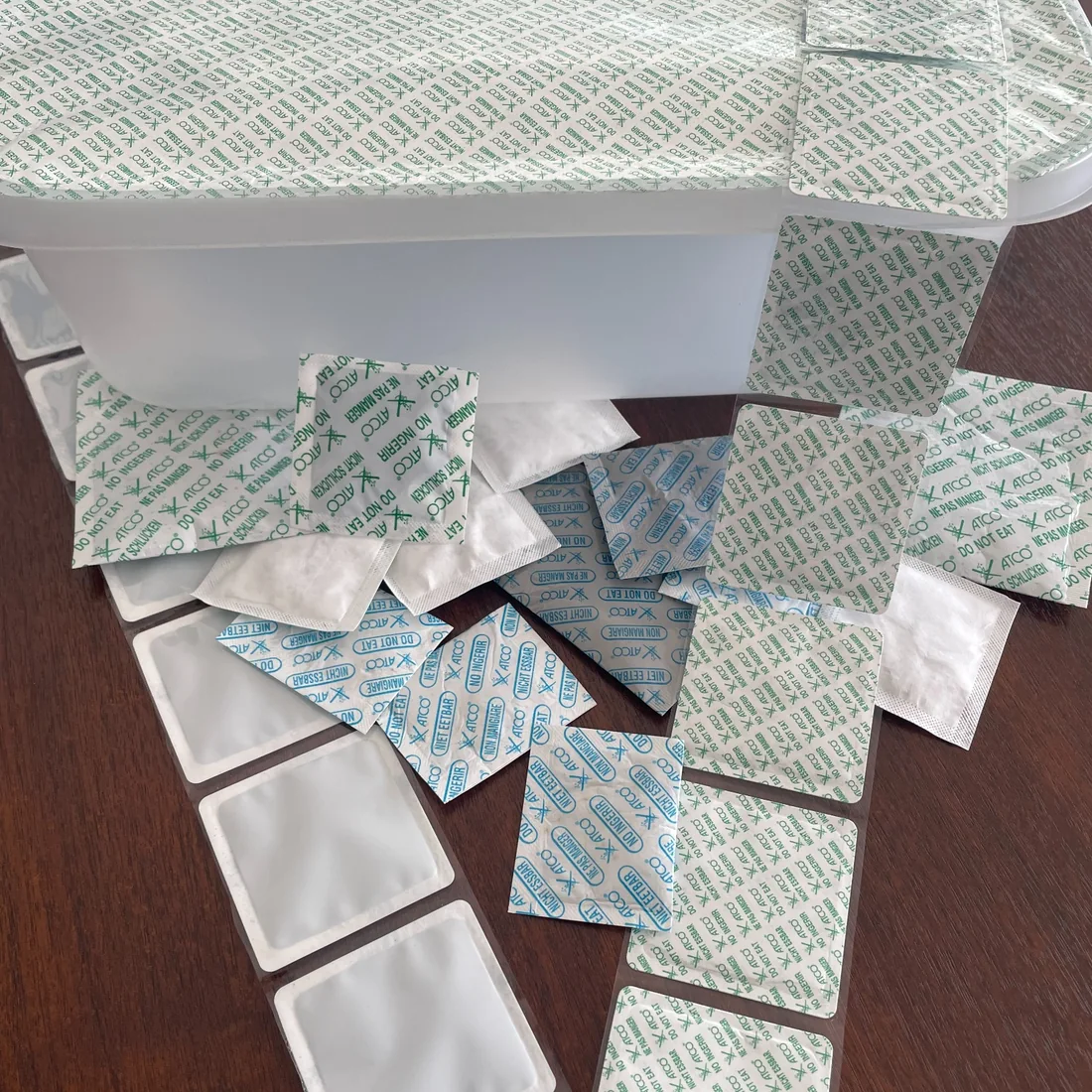
An oxygen absorber (also called an oxygen scavenger) makes sense when the oxygen left inside a package, or the oxygen that gets in later, is what spoils the product. According to Laboratoires Standa, which markets the ATCO brand, absorbers remove the oxygen around the product, the oxygen held within the product itself and the oxygen that seeps through the packaging, until anoxic conditions are reached.
The reasons to use them fall into two groups: protecting the product (flavour, colour, texture, nutritional value) and simplifying operations (fewer additives, no gas-flushing equipment, more storage headroom). That said, the real-world effect depends on the product, the package, the seal and the storage conditions. No absorber guarantees a given shelf life on its own: every company needs to validate it with its own tests, including any microbiological testing that applies.
If you want to know how absorbers work inside or how to estimate the capacity you need, see our oxygen absorbers guide. This page answers a different question: is it worth adding them, and in which cases?
The starting point: oxygen inside the package
According to Standa, air is roughly 20% oxygen. When that air is trapped in a package, oxygen can degrade quality through oxidation and encourage the growth of aerobic microorganisms.
What the manufacturer says oxidation does
The effects of oxidation listed by Standa include:
- rancid oils and fats;
- changes in colour and odour;
- loss of nutritional value, such as vitamins;
- the formation of new, potentially toxic compounds;
- bacterial or mould growth that can make the product unfit to eat;
- in short, a shorter shelf life.
The manufacturer adds that oxygen also breaks down sensitive ingredients such as natural colourings, omega-3 fatty acids, flavours and many drugs.
Why "low oxygen" is not always low enough
Reducing oxygen is not the same as removing it. Standa notes that oxidation can occur even at low oxygen levels, and that photo-oxidation can take place at oxygen concentrations below 1%. That is why the manufacturer argues that absorbers are the way to reach a complete absence of oxygen. This is the manufacturer's position; in practice, the level each product needs varies and should be confirmed by measurement.
What an absorber adds that the package alone does not
A good barrier package slows oxygen ingress, but it does not remove the oxygen already inside. According to Standa, an absorber works on three fronts:
- oxygen in the space around the product;
- oxygen dissolved in or trapped within the product;
- oxygen that permeates through the packaging during storage.
The manufacturer states that the ATCO range can bring residual oxygen below 0.01%, starts working within the first hours after sealing and keeps working until the package is opened. These are general range figures: the specific product, temperature, package and amount of oxygen to be absorbed all affect the outcome.
Reasons to use them: the product
Preserving flavour, aroma, colour and texture
The first benefit Standa lists is keeping the product's original sensory qualities: colour, aroma, texture and flavour. It also mentions protecting sensitive nutrients such as vitamins and omega-3 and omega-6 fatty acids.
Cutting back on preservatives and antioxidants
According to the manufacturer, absorbers make it possible to reduce or remove additives such as preservatives, antioxidants and colourings, which supports a shorter ingredient list (clean label). Standa also describes them as compatible with organic regulations. If reformulation is your goal, it has to be validated product by product.
Fragile products and see-through packaging
Standa highlights two less obvious benefits: they allow packaging that shows the product, with no need for opaque materials to prevent photo-oxidation, and they help delicate products such as mousses or puff pastry keep their shape and structure.
Reasons to use them: operations
Low investment and a simple rollout
According to Standa, there is no need to invest in gas, machinery or the upkeep that comes with it: a heat sealer is enough. Absorbers can be placed by hand or with automatic dispensing systems, so the manufacturer considers them suitable for everyone from small artisan producers to industrial plants. It also points out that trials are easy to run in the customer's own facility.
Less waste and more room to plan
Standa links absorbers to longer use-by or best-before dates and, as a result, to fewer products pulled from retail shelves and more flexibility in production planning thanks to longer storage. How much improvement you actually get cannot be generalised; it has to be measured case by case.
Longer shipping routes and smaller packages
The manufacturer explains that building in sachets, labels or boxes has, in many cases, made it possible to shrink package size. As an example, it cites solutions that let moist, fragile foods be exported by sea instead of by air, a longer but cheaper route.
Do they replace modified atmosphere packaging?
Not necessarily. According to Standa, ATCO absorbers are compatible with modified atmosphere packaging (MAP), so the two techniques can be combined, and the absorber keeps working after sealing until the package is opened. Which combination is right depends on the product and should be decided through testing. If you already use MAP, a MAP gas analyzer lets you measure the headspace and compare results with and without an absorber.
Where they are used
Applications cited by Laboratoires Standa (they do not mean that a given product is suitable for every application):
| Sector | Examples cited by the manufacturer |
|---|---|
| Food | meat, ready meals, bread, seafood and shellfish, vegetables, fruit, herbs and spices, seeds and nuts, powdered milk, pet food |
| Pharma and healthcare | nutrition pouches for patients and infants, active ingredients (including vitamins), oxygen-sensitive solutions, medical devices |
| Industry | paints, electronics, rubber |
| Large volumes | solid or liquid bulk goods, from 30 litres to several cubic metres (ATCO Box) |
According to the manufacturer, they work for both solid and liquid products; liquids require double packaging.
Before you decide: questions worth answering
- Is the spoilage driven by oxygen? If the defects you see match the effects of oxidation described above (rancidity, changes in colour or odour, loss of aroma), an absorber is worth evaluating. If the problem has another cause, an absorber is not designed to fix it.
- Are the package and seal up to the job? Standa specifies that absorbers should be used in suitable packaging. If oxygen gets in faster than the absorber can take it up, the result will not hold.
- Is the product or environment dry or moist? There are pre-activated absorbers for dry products or environments and others that are activated by moisture.
- Single packages or large volumes? For an individual package, a sachet or label; for bulk goods, barrels or enclosed spaces, ATCO Box.
- How will you check it? With oxygen indicators or an analyzer, in addition to your own shelf-life tests.
Limitations to keep in mind
- The effect ends when the package is opened. According to Standa, from that point on the product behaves like any other preservative-free product, and the absorber cannot be reused.
- The contents are not edible. The manufacturer describes them as non-toxic but not meant to be eaten, and advises keeping absorbers away from children and pets.
- Having an absorber in the package does not, on its own, prove that the product is microbiologically safe or that it will reach a particular shelf life.
The ATCO products in our catalogue
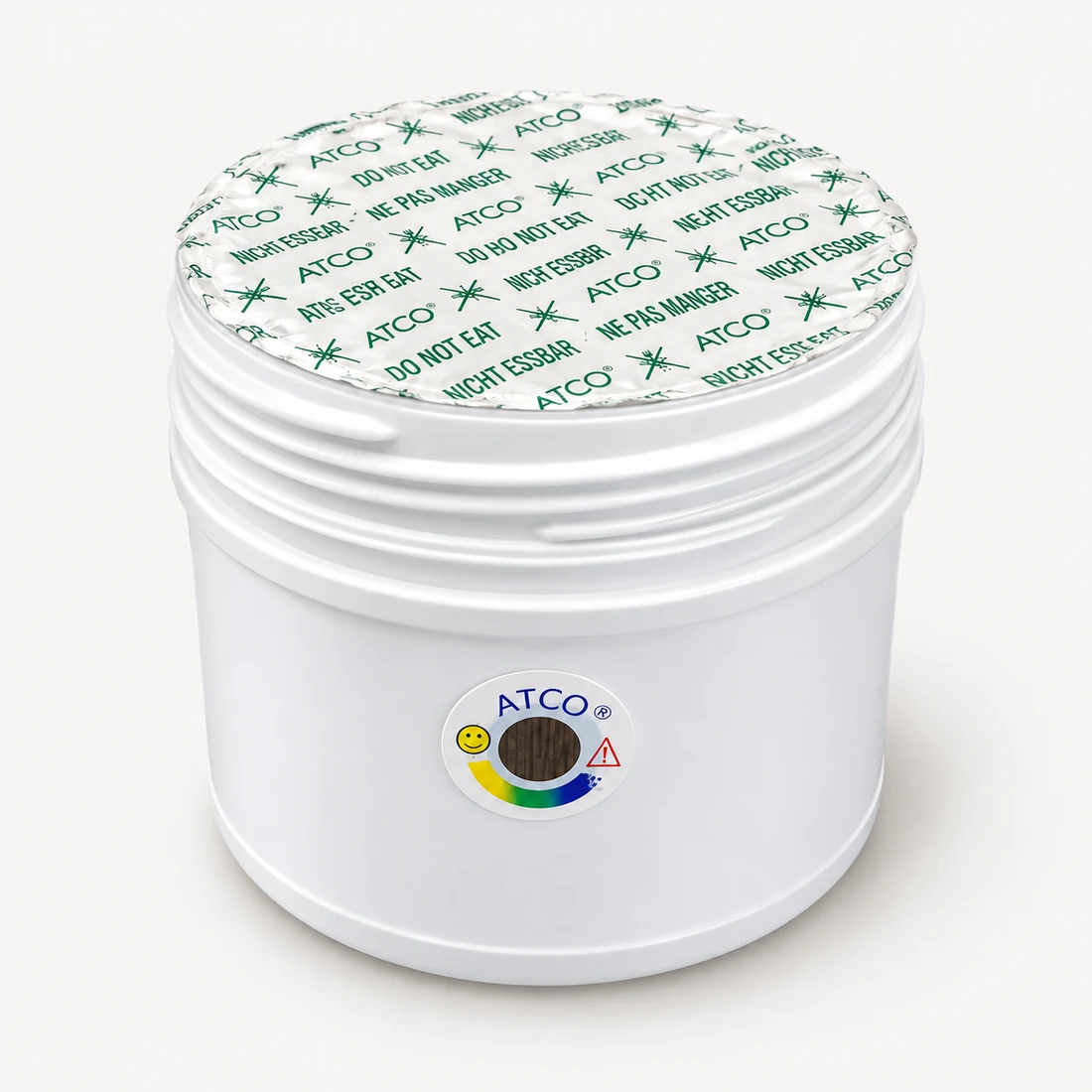
At Control y Suministros we carry five ATCO products: three that absorb oxygen and two that show whether oxygen is still present in the package.
| Product | What it does | Learn more |
|---|---|---|
| Sachet absorber | Placed loose inside the package | ATCO oxygen absorbers |
| Adhesive label absorber | Attached to the inner wall of the package, taking up no extra space | ATCO oxygen absorbers |
| ATCO Box | Anoxia for large volumes: bulk goods, barrels and enclosed spaces | ATCO Box |
| I-A20 indicator | Self-activating; changes colour when oxygen is present | Oxygen indicators |
| I-S120 indicator | Heat-activated, for processes that include a sterilisation step | I-S120 |
Capacities and conditions of use for each product are given in its current data sheet, which we can send you on request.
How to validate the result on your product
An absorber is validated with data, not assumptions. A sensible approach combines:
- oxygen indicators, which give a visual signal inside the package;
- headspace measurements with an analyzer (see our guide to oxygen analyzers for MAP packaging);
- your own shelf-life tests, both sensory and microbiological, under real storage and distribution conditions.
What documentation to ask for
Before adding an absorber, ask for the current data sheet for the product. According to Standa, its products are subject to specific food-contact regulations, notably Regulation (EC) No 450/2009, and have been assessed by EFSA. If your quality records require it, ask about the food-contact documentation you need.
Frequently asked questions
Will an oxygen absorber extend the shelf life of any food?
That cannot be stated in general terms. The manufacturer associates absorbers with longer use-by or best-before dates, but the result depends on the product, package, seal and storage, and must be validated with your own tests.
Do I need a modified atmosphere packaging machine to use them?
No. According to Laboratoires Standa, a heat sealer is enough. If you already pack under modified atmosphere, the manufacturer states that its absorbers are compatible with it.
Do they keep working after the package is opened?
No. According to Standa, they protect the product while the package stays sealed; once it is opened, the product behaves like any other preservative-free product, and the absorber cannot be reused.
Can they be used with liquid products?
According to the manufacturer, yes, with double packaging. ATCO Box is also intended for solid or liquid products in large volumes.
Are they safe for food contact?
According to Standa, they are subject to Regulation (EC) No 450/2009 and have been assessed by EFSA; the contents are non-toxic but must not be eaten. Ask about the food-contact documentation you need for the product you plan to use.
How do I know the absorber is working?
With oxygen indicators inside the package, or by measuring the headspace with a gas analyzer.
Product advice
Tell us what you pack, what packaging you use and how you store it, and we will help you choose which ATCO format to trial.
Control y Suministros, S.L. · Ronda General Mitre 126, 6th floor, 08021 Barcelona, Spain · Tel. +34 933 409 759 · comercial@controlysuministros.com · Contact form
Sources
- Laboratoires StandaATCO oxygen absorbershttps://www.standa-fr.com/absorbeurs-doxygene-atco/ (opens in a new window)
- Laboratoires StandaPrinciples and automationhttps://www.standa-fr.com/principes-et-automatisations/ (opens in a new window)
- Laboratoires StandaATCO active packaginghttps://www.standa-fr.com/en/atco-en/ (opens in a new window)
- Laboratoires StandaFood industryhttps://www.standa-fr.com/agro-alimentaire/ (opens in a new window)
- Laboratoires StandaResearch and healthhttps://www.standa-fr.com/sante/ (opens in a new window)
- Laboratoires StandaOther industrial sectorshttps://www.standa-fr.com/autres-secteurs-industriels/ (opens in a new window)
- Laboratoires StandaLarge volumeshttps://www.standa-fr.com/grands-volumes/ (opens in a new window)